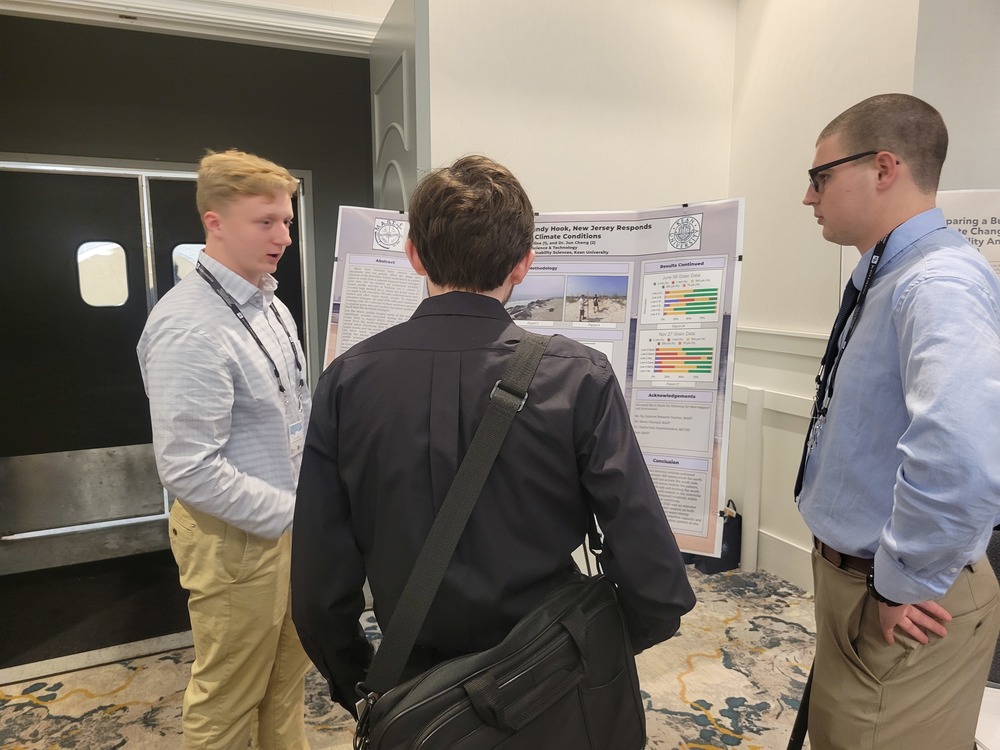
Sandy Hook, NJ — As shore communities across New Jersey face increasing impacts from storms and erosion, Marine Academy of Science and Technology (MAST) seniors Donovan Post of Oceanport and Andrew Prodeline of Manasquan are contributing to the conversation through research on how seawall-protected beaches respond to changing conditions.
The students presented their capstone research at the 2026 New Jersey Coastal and Climate Resilience Conference, where hundreds of coastal and climate resilience professionals gathered to share research and collaborate on solutions to protect Jersey shore communities.
Conducted under the mentorship of Dr. Jun Cheng of Kean University, the student-led research examined how a seawall-protected beach responds to storms and typical climate conditions. Their research focused on seasonal sediment movement and the impact of hard shore stabilization structures, such as seawalls and bulkheads, used to prevent erosion.
Their findings showed a clear disruption in natural sediment transport patterns. During the summer and fall months, sediment accumulated south of the seawall while erosion occurred to the north, largely due to wave energy moving from south to north. In the fall and winter months, this pattern reversed, with sediment building up north of the seawall and decreasing to the south as wave energy shifted direction. In both cases, the area directly at the seawall remained relatively stable, demonstrating how such structures can interrupt the natural movement of sand along the shoreline.
Presenting at a professional conference provided the students with the opportunity to share their findings with scientists, engineers and policymakers working in coastal resilience and environmental management, contributing to ongoing discussions about shoreline protection and sustainability.
“I was very excited to present our project to professionals in the field, which is something not many high school students get to experience,” said Post. “It allowed me to learn more about beach morphology by speaking with experts conducting in-depth research.”
Prodeline said his interest in coastal research was shaped by years of visiting the Jersey Shore and observing how beaches change over time. His continued studies at MAST, located on Sandy Hook, further deepened that interest through direct observation and fieldwork.
“Our project was the culmination of our four years at MAST,” said Prodeline. “Learning from professionals such as our mentor, Dr. Cheng at Kean University, was an incredible experience, and seeing the final product of years of work is an unbeatable feeling.”
The research was conducted as part of the students’ Senior Capstone Research course, a year-long class required of all graduating seniors at the Marine Academy of Science and Technology. The course, taught under the supervision of science teacher Clare Ng, is designed to integrate K-12 subject areas into a culminating, student-driven independent research project.
About Monmouth County Vocational School District
MCVSD operates six full-time Career Academies including the Academy of Allied Health and Science, Academy of Law and Public Safety, Biotechnology High School, Communications High School, High Technology High School and Marine Academy of Science and Technology. Each welcomes students as freshmen and retains those students through their senior year of high school, for a focused learning experience that helps them take meaningful steps toward their college and career goals.
MCVSD also operates more than 30 shared-time programs, a Career Center for students with special needs and adult programs. Questions about the admissions process for the MCVSD Career Academies or any other career and technical education program offered by MCVSD should be directed to applications@ctemc.org.